Blog

  • Close or far away? The neighbouring country in Dutch and German regional newspapers

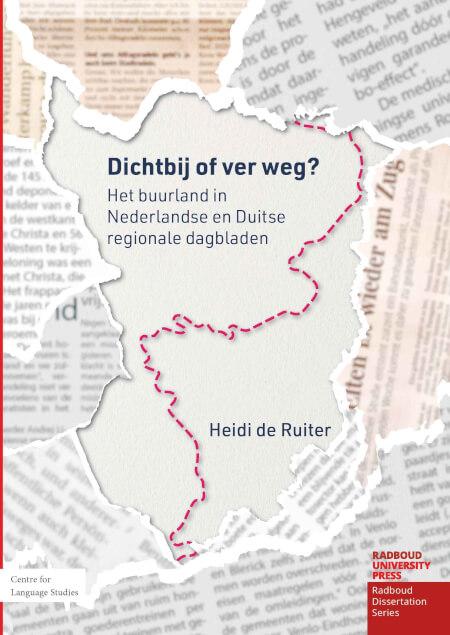
    On Tuesday May 12, 2026, Heidi de Ruiter defended her PhD thesis Close or far away? The neighbouring country in Dutch and German regional newspapers, which she wrote under the supervision of Paul Sars, Suzanne Brouwer, Wilbert Spooren and me. Here is the summary:

    This research aims to provide insight into how regional newspapers in the Dutch-German border region of Euregio Rhine-Waal deal with their unique geographical position: their location on the border. The significance of this position extends beyond the local context, as it links national and European ambitions for European cooperation with everyday life at the local level. Various methods were employed for this research: 1) frequency analysis, 2) analysis of geographical place references, 3) content analysis and 4) interviews with editorial teams. The results show that there is a correlation between distance from the border and the extent of reporting on the neighbouring country in regional daily newspapers, but that this correlation manifests itself differently in the Netherlands and Germany and, moreover, varies between the front pages and regional sections. The manner of reporting on the neighbouring country also differs between the two countries. Furthermore, it appears that regional media define the border region on either side of the border more narrowly than the administrative area of the Euregio. The perceived border region is thus smaller than the administrative one. The European reality of cross-border Euregios therefore does not yet correspond to the Euregional representation in the newspapers of the Dutch-German border region.

    The dissertation can be downloaded here (in Dutch)

  • Marking L2 written exam answers in an EMI context: no effect of ELF and no foreign language effect on grading by university lecturers

    New article, with Lidy Zijlmans and Roeland van Hout. You can find it here.

    Abstract:

    We aim to contribute to the discussion on whether the use of English in higher education in an international setting affects study outcomes. Previous research comparing instruction in English versus instruction in the students’ L1 yielded contradictory results. Our concrete interest was how the reader-marker of exams evaluates the content knowledge of a student-writer who expresses themself in English as a lingua franca. The experiment consisted of grading tasks in two language conditions complemented by an online questionnaire. We presented L1 Dutch professional university lecturers with different versions of answers originally written in English and Dutch both as L2, by German students. The versions varied in L2 CEFR levels. We investigated whether the versions would be assessed differently and/or would influence the grades. We found no effect of (a) the condition “marker reads in their first language versus in their second language” when assessing whether an exam answer met content criteria, or (b) differences in CEFR-based proficiency (lexical and grammatical accuracy). When grading written answers to an exam question in an EMI high education setting, lecturers weigh content criteria and are not distracted by poor formulations, due to students’ lower proficiency in English. This outcome points out that ELF is an acceptable communicative variety in an EMI context.

  • Pronouncing Acronyms in Esperanto

    Abstract:

    This chapter investigates how fluent Esperanto speakers pronounce acronyms, replicating and extending Torres-Tamarit and Martínez-Paricio’s (2024) study of Spanish acronyms. Although Esperanto was designed to be maximally regular, no prescriptive rule was ever laid down for the pronunciation of letter sequences, making acronyms a revealing test case for emergent phonological constraints. We gathered data from 48 experienced speakers on their preferred pronunciations of acronyms varying in length and phonological structure. The results show a highly systematic pattern: longer acronyms that can form multi-syllabic words are almost always pronounced as whole words with regular penultimate stress, while two-letter acronyms are predominantly spelled out. Three-letter acronyms occupy a transitional zone, with monosyllabic options showing substantial variation. These patterns closely parallel the Spanish findings, suggesting that the same universal phonological constraints (including a prosodic minimality requirement and a preference for trochaic feet)  govern acronym pronunciation regardless of whether the language is ‘natural’ or ‘constructed’. The findings demonstrate that Esperanto speakers have developed unwritten conventions that mirror those of natural languages, underscoring the role of universal grammar in shaping even a planned language’s phonology.

    The paper (to be published in a handbook on Esperanto studies) is on LingBuzz

  • Diphthongs in Dutch

    I wrote a chapter on Dutch for a handbook on polyphthongs in the world’s languages. Below is the abstract. The manuscript is on LingBuzz


    The core of the Dutch diphtong system are three diphthongs, one at each of the major places that Dutch also reserves for monophtongs: front unrounded /ɛi/, front rounded /ʏy/ and back rounded /ɑu/. In this chapter we first discuss these three core diphtongs, their historical origin and their place in the current system.

    We also compare these to two other sets. The first are the so-called ‘false dipthongs’ /uj, aj, oj, iw, ew/. These differ from the ‘real’ diphthongs in that the consist of vowel parts that are at different places of articulation (whereas real diphtongs are all in one place, differing only in height), and in their syllabification properties (true dipthongs allow non-coronal consonants in the coda, but false dipthongs do not).

    The second set to which true diphthongs need to be compared are the mid vowels which in (Netherlands) Dutch tend to be diphtongized at least phonetically: /ej, øj/øw and ow/. Again the syllabification properties are different and in spite of their phonetics they phonologically still seem to fit completely in the set of monophthongs.

  • Magnetic Grammar. A bugfix

    In D’Alessandro & Van Oostendorp (2020), we proposed Magnetic Grammar, a model of phonological competence in which a language’s segment inventory is characterised entirely by features that attract or reject other features within a segment. The paper referred to a Python implementation demonstrating the learning algorithm. This squib reports on a bug in that implementation and presents a corrected version, which leads to a small but theoretically meaningful refinement of the learning algorithm.

    The corrected implementation, with Jupyter notebook in which one can learn about and test the updated theory, is available as an open-source repository at https://github.com/fonolog/MagneticGrammar. A short explanation is on LingBuzz. The original paper is here.

  • Textbook online

    Here is a recent version of my free textbook on Phonology (always under construction).

  • New article: Looking at Language with Chatbots

    The Dutch scholarly journal TNTL just published my article ‘Looking at Language with Chatbots’. Here is the link; the abstract is here:

    The rise of Large Language Models (LLMs) has profound implications for both research and education, also within linguistics. This article explores how chatbots can serve as innovative tools for the didactics of reflection about language and language use. Using concrete examples from interactions with LLMs, it demonstrates how these technologies make the four perspectives on language formulated by the Dutch Meesterschapsteam Nederlands (20162018) – language as a system, as an individual phenomenon, as a social phenomenon, and as a historical phenomenon – accessible in new and interactive ways. At the same time, working with LLMs in the classroom highlights the fundamental differences between human language processing and the computational approach of LLMs, including criticisms of the nature of their ‘understanding’ and ‘creativity’. The article argues for a critical integration of chatbots into Dutch language and literature education, with an emphasis on ‘conscious literacy’ and experiential learning, and discusses the ethical considerations as well as the shifting role of the Dutch studies scholar in this new landscape.